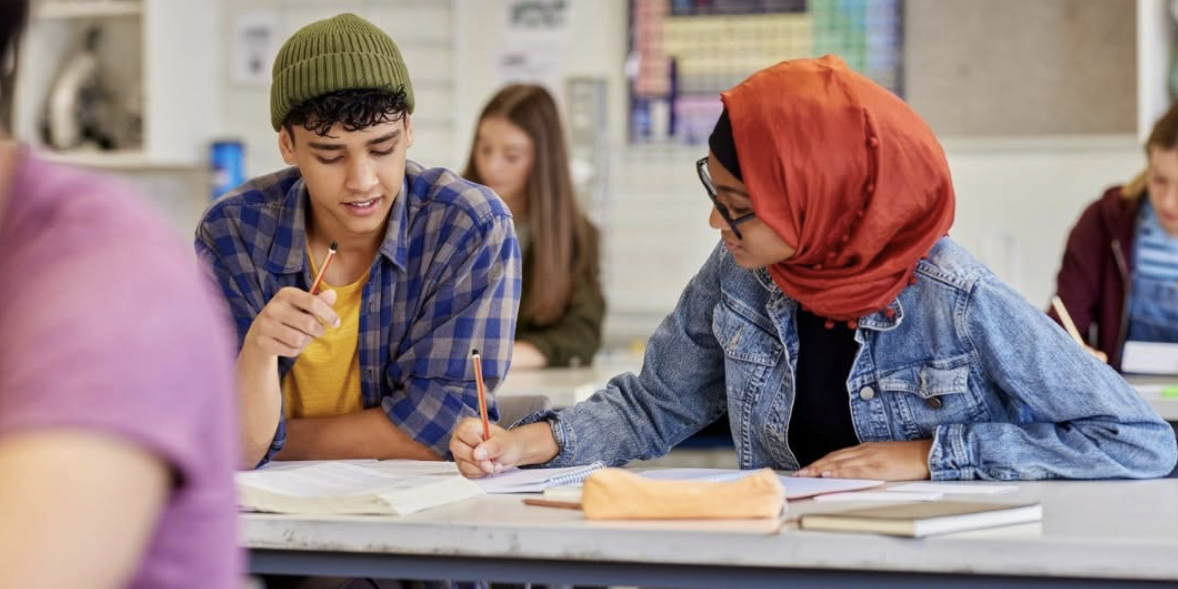
For some time now, we have been reflecting on the words we use to talk about people, because we do not believe that words are ever just words: they create categories, draw boundaries and, sometimes, produce distances that do not actually exist. This is why we increasingly prefer to speak of people with an international background, because it seems to us a way of acknowledging a person’s individual and family history without turning that history into their primary identity, without defining them as foreign, and without necessarily reducing them to their own or their parents’ migration experience, thereby avoiding confining them within categories such as the now widely used term “second generation”.
This reflection becomes even more important when we look at the way political debate has addressed the presence of students with a migration background in Italian schools in recent years, including the recent discussion around a cap on the number of foreign students in classrooms, “ghetto classes”, and even the risk of Italians becoming a minority. The problem with this kind of narrative is that it ends up placing profoundly different realities into the same category: on the one hand, there are girls and boys who arrived in Italy only a few months ago and who need to learn Italian and be supported throughout their educational and integration journey; on the other, there are girls and boys who were born and raised in Italy, speak perfect Italian, attend the same schools as their peers and share the everyday life of the cities where they live, yet continue to be described as foreigners simply because they have a surname or a family history that tells a different story of origin.
It is precisely this political and communicative approach that we believe needs to be challenged, because when the focus is placed on the presence of “foreigners in classrooms”, on the risk of Italians becoming a minority, or on the need to set a limit on the presence of certain students, the result is to exploit fears and resentment that already exist within society while, at the same time, creating a dangerous confusion between those who have only recently arrived and still need to learn the language and those who were born and raised in Italy but are still portrayed as though they came from somewhere else. In this way, an issue that should first and foremost be addressed as an educational issue is transformed into an identity issue, shifting attention away from the resources needed to guarantee everyone’s right to education and towards the supposed need to protect a “we” from the presence of a “them”.
This is where political responsibility should be stronger and more concrete: we need to seriously discuss how schools can support students arriving in Italy who do not yet speak Italian, and we need to talk about resources, teachers, language mediation, literacy courses, training and the tools needed to support not only students, but also their families and the educational communities that welcome them. These are the real issues that should be at the centre of the debate, because framing all of this through the language of “foreigners in classrooms” means deliberately shifting the problem from an educational issue to an identity issue, once again fuelling an opposition between a “we” and a “them” that risks becoming increasingly difficult to overcome.
And then there are those girls and boys whom we continue to call “second generations”, a definition that often says more about the way we look at them than about how they themselves experience their identity. These girls and boys are not a generation “in between”, they are not less Italian and they are not permanent guests in a society that still somehow considers them to have come from elsewhere: they are girls and boys who were born and raised here, who may have parents who arrived from another country, who may speak several languages, have family members and loved ones living in different places, and carry different cultural references with them, but who do not need to be defined through the journey their parents made.
They are young people with multiple identities, with cognitive and emotional landscapes shaped by several languages, cultures, memories, experiences and ways of seeing the world. Young people who do not need to choose between one belonging and another because they can feel deeply Italian while, at the same time, carrying within them the history, culture and memory of their families. It is precisely this complexity that we should learn to recognise as a resource rather than a problem to be reduced to simple categories, because identities are not closed boxes and people cannot be reduced to a single belonging, a place of birth or their family’s migration history.
Perhaps it is time to change the questions we ask people as well, and to stop constantly asking where they come from, and instead start asking ourselves where they want to go, what they are building, what relationships they are creating, what dreams they are pursuing and what contribution they are making to the community they are part of. Having an international background does not mean being foreign and, above all, it does not mean belonging any less to this country: it means having one story, or several stories, that intersect and can become a resource for the whole community; it means being able to look at reality from different perspectives and build connections between different worlds.
Perhaps this is precisely the kind of society we should learn to see and recognise: a society in which identities are not rigid boundaries but journeys in motion, in which the plurality of experiences is not perceived as a threat but as an opportunity for transformation, and in which no one should feel compelled to constantly prove that they belong to a particular place, because belonging also means participating, contributing, building relationships and imagining the future together.
Having an international background does not mean being foreign, and it does not mean belonging any less to this country. It means being part of a society that changes, grows and transforms, also thanks to the stories of the people who inhabit it. And this government needs to come to terms with that.
Stopka kasyna online niemal zawsze wskazuje regulatora i numer licencji. Te informacje sa weryfikowalne i to pierwsza kontrola przed wplata. Trzeba tylko wiedziec, co licencja realnie obejmuje, a co zostawia na boku.
Znalezienie i weryfikacja numeru licencji
Numer pojawia sie na dole strony, czesto z linkiem do rejestru regulatora, gdzie wpis musi dokladnie odpowiadac nazwie spolki prowadzacej. Gracze, ktorzy chca to sprawdzic przed rejestracja, moga casino bison i porownac wymienionych operatorow. Numer wyswietlony, ale nie do znalezienia w rejestrze to sygnal do potraktowania powaznie.
| Punkt | Rama wymagajaca | Rama minimalna |
|---|---|---|
| Rejestr publiczny | Dostepny | Ograniczony |
| Mediacja | Niezalezna | Wewnetrzna |
- Licencja reguluje spory, nie Twoje wyniki
- Sprawdz istnienie niezaleznego mediatora
- Przeczytaj procedure reklamacji, zanim bedzie potrzebna
Sprawdzenie licencji zajmuje dwie minuty i eliminuje jedyna naprawde kosztowna kategorie problemu, ta z kasynem, ktore nie placi. To kontrola podstawowa, nie ubezpieczenie. Przewaga kasyna istnieje u najlepiej regulowanych operatorow tak samo jak u innych, wiec trzymaj okreslony budzet.